

From 3D Chips to Green Hydrogen: NTHU Engineers Reimagine Artificial Photosynthesis
NTHU Researchers Bring 3D-IC Thinking to Solar Hydrogen Production
 As the semiconductor industry moves toward three-dimensional integrated circuits (3D-ICs), vertical stacking has become a powerful strategy for overcoming the limits of planar architectures and increasing functional density within a limited area. Can the same concept be applied to solar energy conversion and artificial photosynthesis?
A research team led by Professor Ho-Hsiu Chou from the Department of Chemical Engineering at National Tsing Hua University (NTHU) has recently reported a new 3D-IC-inspired photocatalytic platform for solar hydrogen production, published in Nature Communications (2026, 17:5418). By integrating organic semiconductor photocatalysts into a swelling-enabled polymer matrix and stacking the resulting films vertically, the team developed a new artificial photosynthesis architecture designed to improve land-use efficiency and enhance hydrogen production per unit area.
The study addresses a long-standing challenge in photocatalytic hydrogen production. Conventional systems often rely on powdered photocatalysts dispersed in solution or single-layer thin-film designs. While these approaches can be effective at the laboratory scale, they face major obstacles in practical implementation, including catalyst sedimentation, film delamination, inefficient charge transport, limited light utilization, and low hydrogen output per unit land area.
Inspired by 3D-IC Architecture
To overcome these limitations, Professor Chou’s team rethought photocatalytic device design from an architectural perspective. Just as 3D-IC technology increases computing density by stacking functional layers vertically, the team proposed that photocatalytic materials could also be arranged in a three-dimensional configuration to increase solar fuel production within a limited footprint.
At the core of this strategy is a flexible and swelling-enabled polymer matrix that immobilizes organic semiconductor photocatalysts without relying on rigid substrates. During the reaction, the matrix absorbs the hydrogen-generating solution and creates pathways for water and sacrificial agents to reach the catalytic interface. This swelling behavior enhances solvent accessibility, promotes interfacial charge separation, and supports more efficient charge transport during photocatalysis.
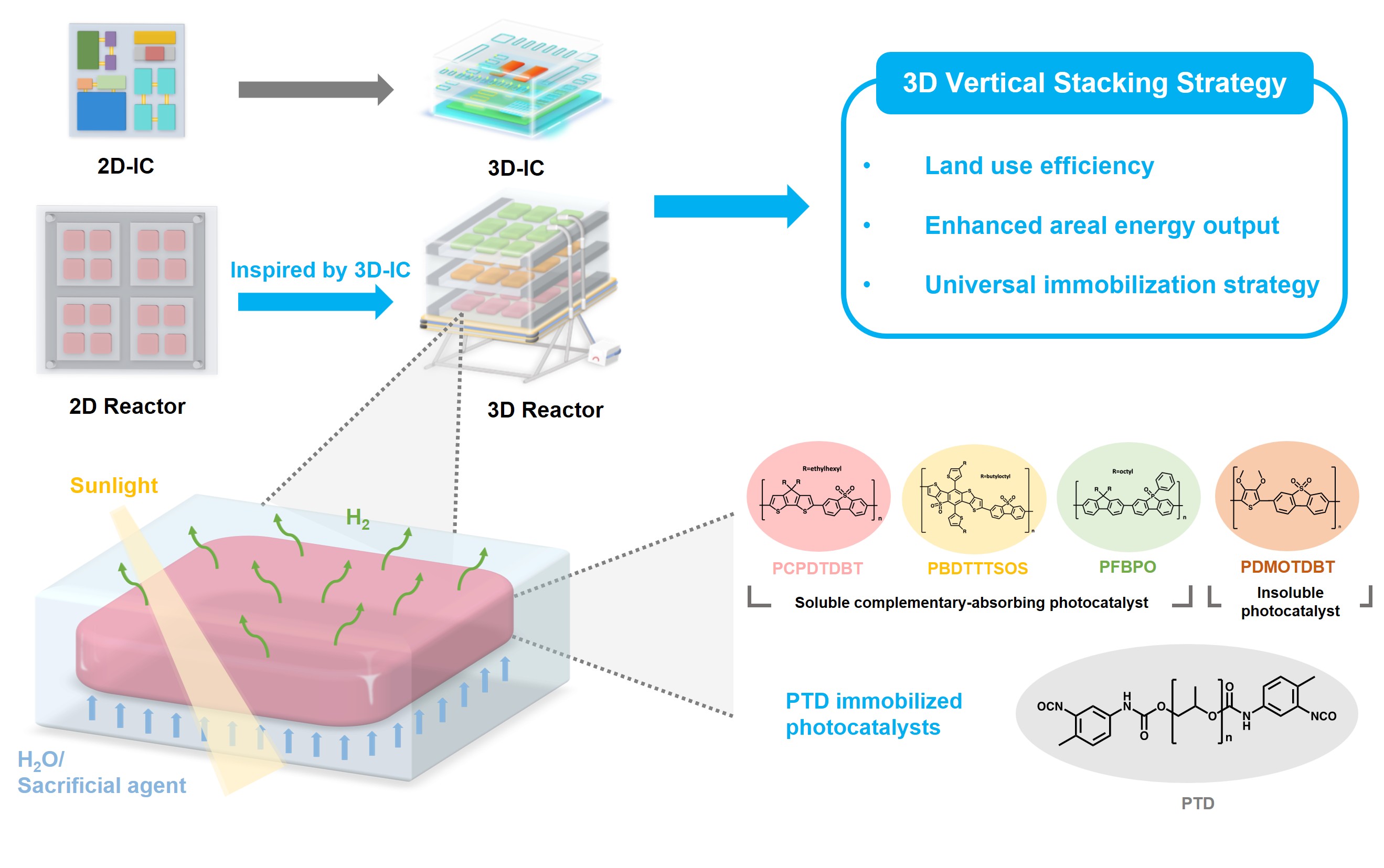
Conceptual illustration of the 3D-IC-inspired artificial photosynthesis.
Toward Land-Efficient Solar Hydrogen Production
The team further assembled the photocatalytic films into a vertically stacked reactor, creating a 3D artificial photosynthesis system. In this architecture, multiple catalytic layers are arranged within the same projected area, increasing light absorption and expanding the reaction interface between the photocatalysts and the solution.
Experimental results showed that the three-layer stacked configuration achieved nearly five times higher hydrogen production per unit area than a single-layer film. The team also introduced a spectral-splitting strategy by layering different polymer photocatalysts that absorb different regions of the visible spectrum. Instead of mixing multiple materials together, which can lead to energy-transfer losses and charge recombination, the stacked design allows each layer to harvest a specific portion of sunlight more effectively, further improving hydrogen evolution compared with a bulk-mixed configuration.
A New Device Concept for Artificial Photosynthesis
The significance of this work lies not only in improving material performance, but also in proposing a new way of designing solar fuel systems. Future artificial photosynthesis technologies may need to move beyond optimizing individual photocatalysts and instead adopt a more integrated approach that combines materials design, device architecture, and spatial organization.
By translating the logic of 3D integration from semiconductor engineering to solar hydrogen production, Professor Chou’s team opens a new pathway for developing high-density solar fuel devices. This concept may be particularly important for future green hydrogen systems where land availability, device scalability, and long-term stability are critical considerations.
This achievement highlights the interdisciplinary strengths of the NTHU College of Engineering in organic semiconductors, polymer materials, photocatalysis, and sustainable energy systems. As global demand for sustainable energy continues to grow, the 3D stacking platform developed by Professor Ho-Hsiu Chou’s team provides a promising framework for scalable and sustainable solar-driven hydrogen production.
Share