

Brighter, Faster, and More Stable: Advancing Room-Temperature Quantum Light Sources
NTHU Researchers Set a New Benchmark for Room-Temperature Quantum Light Sources
 Quantum technologies—including quantum communication, quantum computing, and quantum encryption—rely critically on single-photon sources capable of emitting exactly one photon at a time. However, achieving ultrabright, ultrafast, and stable, non-blinking single-photon emission at room temperature has long been one of the greatest challenges in quantum photonics.
A research team led by Professor Hao-Wu Lin from the Department of Materials Science and Engineering at NTHU has recently achieved a breakthrough, published in the prestigious journal Science Advances. By integrating perovskite quantum dots with plasmonic nanocavities, the team developed one of the world’s brightest room-temperature single-photon sources. The device reaches an extraordinary emission rate of 2.3 billion photons per second—approximately 250 times brighter than the team’s previous record. This work establishes a new benchmark for room-temperature quantum light sources and opens exciting new opportunities for the future of quantum communication and photonic chip technologies.
From “Cavity-Free” Quantum Emitters to True Quantum Nanocavities
Several years ago, Professor Lin’s group reported the world’s brightest cavity-free room-temperature single-photon source in ACS Nano, achieving approximately 9 million photons per second. In this new study, the team further advanced the technology by successfully coupling CsPbI3 perovskite quantum dots with ~100-nm silver nanocubes to create a plasmonic nanocavity featuring strong light-matter interaction.
One of the major challenges in this integration was the inherent incompatibility between the two materials. Silver nanocubes require highly polar solvents, such as isopropanol, for dispersion, while conventional perovskite quantum dots rapidly degrade and lose their quantum properties in such environments. To overcome this issue, the researchers innovatively introduced zwitterionic surface ligands. Functioning like a “nanoscale raincoat,” these ligands protected the quantum dots from polar solvent damage, enabling their flawless integration with the plasmonic nanocavities.
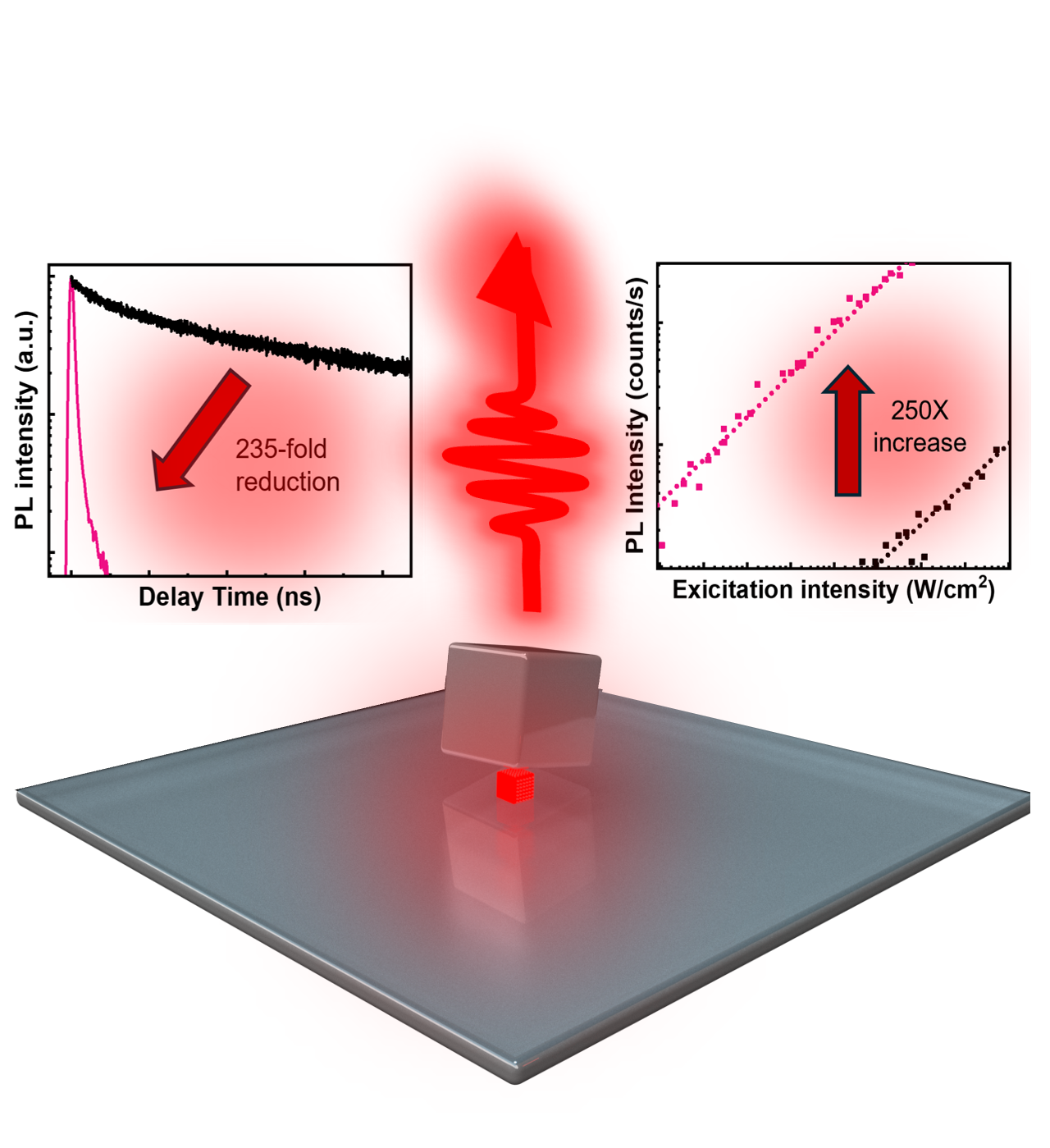
This plasmonic nanocavity structure enables an ultrafast spontaneous emission rate for the quantum dots, simultaneously achieving a significantly enhanced total emission intensity.
So Bright That the Detector Saturated
Using a custom-built confocal microscope developed in-house, the team discovered that the emitted photon intensity was so high that the single-photon detector became completely saturated. “It was like pointing a camera directly at the sun—the detector was completely overexposed,” Professor Lin explained. To successfully complete the measurements, the researchers had to install multiple neutral density filters in front of the detector, acting much like sunglasses for the equipment. Ultimately, they recorded an unprecedented emission rate exceeding 2.3 × 10⁹ photons per second, setting a new brightness record for room-temperature single-photon sources. Equally important, the device simultaneously demonstrated several quantum optical properties that are rarely achieved together at room temperature, including an ultrafast emission of less than 12 picoseconds, high-purity single-photon characteristics, and stable, non-blinking operation.
Solving the Quantum Dot “Blinking” Problem
Quantum dot materials have long suffered from “blinking,” a notorious phenomenon in which their light emission randomly switches between bright and dark states. This instability severely limits their practical applications in quantum communication and computing. While previous studies have attempted to improve brightness by placing traditional quantum dots inside optical cavities, these approaches often sacrificed single-photon purity.
In contrast, Professor Lin’s team demonstrated that CsPbI3 perovskite quantum dots can maintain excellent single-photon performance inside plasmonic nanocavities while successfully suppressing this blinking behavior. The researchers attribute this breakthrough to the dramatically accelerated radiative rate induced by nanocavity. This ultrafast process allows the quantum dots to emit photons rapidly before non-radiative pathways—such as Auger recombination—can force them into a dark state, thereby effectively eliminating the blinking effect.
Advancing Quantum Materials and Nanophotonics at the Department of Materials Science and Engineering, NTHU College of Engineering
This achievement highlights the profound strength of the NTHU College of Engineering in the fields of advanced quantum materials, perovskite optoelectronics, nanophotonics, and quantum measurements. The research team independently developed the entire experimental workflow—from material synthesis and nanostructure design to high-sensitivity quantum optical characterization. This includes the custom-modified confocal microscope platform used in this study, thoroughly demonstrating the College’s exceptional interdisciplinary integration and autonomous research capabilities.
As global competition in quantum technologies rapidly accelerates, ultrafast, ultrabright, and stable single-photon sources are poised to become the core enabling components for next-generation quantum communication, quantum computing, and integrated photonic chips. This breakthrough by Professor Hao-Wu Lin’s team not only places Taiwan firmly at the forefront of global quantum photonics research but also creates exciting new opportunities for the future development of the quantum technology industry.
Share