

Nature-Inspired Engineering: Decoding Multifunctional Design Principles from Shark Skin
publish date :
2026-07-24
Professor Po-Yu Chen's Team Establishes a New Framework Linking Morphology, Function, and Evolution

For decades, shark skin has been regarded as one of nature's most elegant engineering solutions. Its microscopic surface structures have inspired studies on drag reduction, high-performance materials, and bio-inspired surfaces.
But drag reduction turns out to be only part of the story.
In a study published in Nature Communications (2026, 17:5853), Professor Po-Yu Chen of National Tsing Hua University (NTHU), together with researchers from Academia Sinica led by Dr. Sheng-Feng Shen, Professor Tsung-Hui Huang at National Taiwan University (NTU), and international collaborators, demonstrates that shark skin is better understood not as a single optimized design, but as a collection of distinct engineering solutions. The research was carried out with major contributions from Dr. Rikke Beckmann Dahl and Dr. Ashish Ghimire, who were doctoral students in Professor Chen's research team during the study. By integrating deep learning, materials characterization, computational fluid dynamics (CFD), and evolutionary analysis, the team established the first comprehensive framework linking shark skin morphology with multifunctional performance across 132 extant shark species.
Rather than asking which surface performs best, the study asks a different question: why have different sharks evolved different surface architectures, and what can engineers learn from those differences?
Looking Beyond Drag Reduction
Most research on shark skin has focused on one characteristic: its ability to reduce hydrodynamic drag. While this property has inspired a wide range of engineering applications, it represents only one aspect of a much more sophisticated natural design.
The researchers found that dermal denticles—the microscopic tooth-like structures covering shark skin—form a remarkable diversity of surface architectures. Some are associated with efficient swimming, while others emphasize mechanical protection, abrasion resistance, or adaptation to particular ecological environments. Instead of converging on a universal design, evolution produced multiple solutions, each reflecting a different balance of functional demands.
This perspective shifts the focus of bio-inspired engineering. Rather than searching for a single "best" biological structure to imitate, engineers may instead ask which natural design best matches a specific engineering objective.
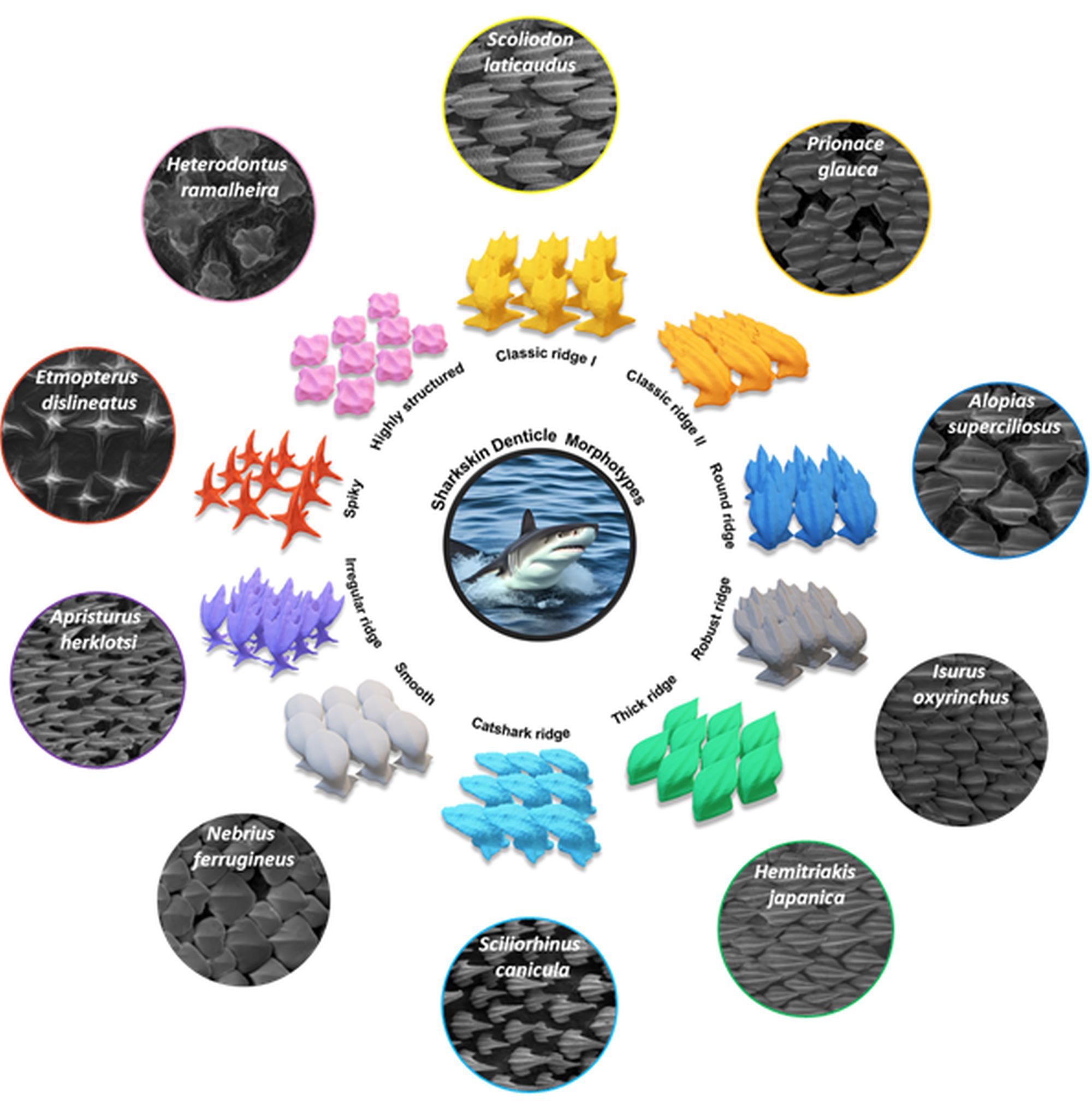
AI-assisted classification of shark skin denticles. By integrating deep learning with morphological analysis, the researchers established the first large-scale framework linking denticle morphology with multifunctional engineering performance and evolutionary diversification.
Teaching AI to Read Shark Skin
The team's first challenge was scale.
Comparing the skin structures of more than a hundred shark species solely through conventional observation would be extraordinarily difficult. To overcome this, the researchers developed a deep-learning framework capable of analyzing more than 2,000 scanning electron microscope (SEM) images collected from 132 living shark species.
The AI classified dermal denticles into ten morphological groups, providing the first large-scale framework for comparing shark skin morphology across evolutionary lineages. The researchers then combined nanoindentation measurements, elemental composition analysis, micro-computed tomography (micro-CT), and CFD simulations to evaluate how each denticle architecture performs under different mechanical and hydrodynamic conditions.
The result is more than a new classification system. It is a framework that connects surface morphology to engineering performance, enabling researchers to compare biological designs systematically and quantitatively.
What Evolution Can Teach Engineers
One of the study's most intriguing findings is that different denticle architectures closely reflect sharks' evolutionary history.
By integrating morphological classification with phylogenetic analysis, the researchers showed that specific surface designs emerged alongside major ecological transitions, suggesting that environmental pressures shaped different engineering solutions over millions of years.
Seen from this perspective, evolution becomes more than biological history. It can also be viewed as a long-term design process—one that has repeatedly tested and refined competing solutions under changing environmental conditions.
For engineers, that perspective may be just as valuable as the biological discoveries themselves.
A New Perspective on Bio-Inspired Engineering
Instead of asking how to reproduce a particular biological surface, it asks why nature arrived at different solutions in the first place. Understanding those underlying design principles may ultimately prove more valuable than replicating any single morphology.
By bringing together artificial intelligence, materials science, fluid dynamics, and evolutionary biology, Professor Po-Yu Chen's team provides a new framework for studying multifunctional biological surfaces. The findings may guide future developments in protective coatings, marine engineering, advanced manufacturing, and other technologies where multiple performance objectives must be balanced simultaneously.
As engineers continue to look to nature for inspiration, this work suggests that the greatest lesson may not lie in copying nature's designs but in understanding the principles that shaped them.
Share