
From Human Protein to Programmable RNA Platform: An Integrated Engineering Strategy for Production, Targeting, and Cancer Therapy
Professor Yu-Chen Hu's Team transform the human PEG10 protein into a modular nanoparticle system that packages RNA, targets cancer cells, and supports combination therapy
mRNA therapeutics offer a powerful way to program cells for cancer treatment, but their broader use still depends on solving several engineering problems at once: economical production, reliable RNA packaging, efficient delivery to selected cells, control of off-target effects, and scalable manufacturing.
A research team led by Professor Yu-Chen Hu in the Department of Chemical Engineering at National Tsing Hua University has now addressed these limitations as a complete engineering system. Published in Nature Communications (2026, 17:7479), the work integrates manufacturing, cargo loading, surface design, storage stability, and therapeutic performance.
|
11.3× |
7,336 nt |
7 months |
≈71% |
Self-Assembly Meets Scalable Manufacturing
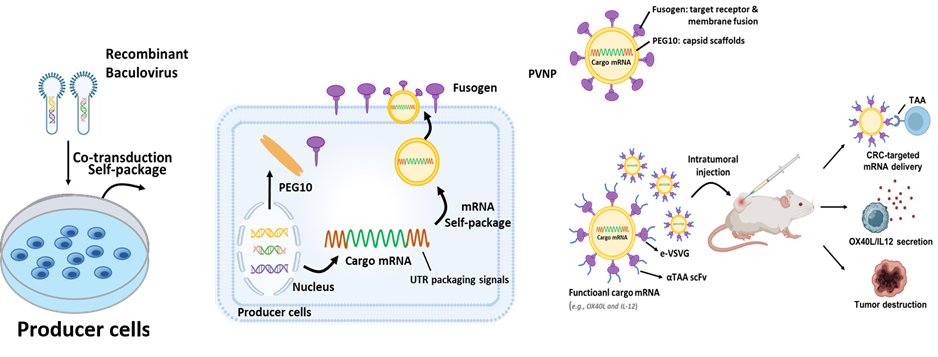
PEG10 naturally assembles into nanoscale particles and can recognize designated RNA cargo. The NTHU team converted this property into a programmable delivery platform capable of packaging RNA at least 7,336 nucleotides long. To overcome the cost and scale limitations of conventional plasmid transfection, the researchers introduced a baculovirus-based manufacturing process. This increased functional particle yield 11.3-fold, lowered production cost, and supported production in suspension cells compatible with biopharmaceutical manufacturing. The approximately 100-nm particles also remained functional after storage at 4°C for seven months.
A Programmable Surface for Efficient Delivery
The particle surface was then treated as an engineerable interface. By adding a cancer-recognition component and optimizing its proportion relative to the membrane-entry component, the team improved RNA delivery to approximately 71% in a colon cancer model and above 60% in several other cancer cell types. This result demonstrates a general design principle: recognition and entry functions can be balanced as interacting system variables rather than optimized independently.
From Delivery Vehicle to Therapeutic System
To demonstrate functional use, the engineered particles delivered a two-component RNA program for cancer therapy. In a mouse tumor model, combining the RNA nanoparticles with oxaliplatin suppressed tumor growth in animals. The RNA was concentrated primarily in tumors rather than major organs, and no evident acute toxicity was detected under the tested conditions.
A Modular Platform with Broader Potential
The significance of this work extends beyond one cancer application. Production method, cargo size, surface targeting, and therapeutic function can each be redesigned for different needs. By integrating process engineering, nanotechnology, biological design, and system optimization, the study highlights the interdisciplinary strength of the NTHU College of Engineering and establishes a route toward scalable, targeted, and programmable RNA medicines.
Share